KLGKleyman Law GroupBusiness & Litigation Attorneys Free Case Analysis(212) 203-2082 KLGKleyman Law GroupBusiness & Litigation Attorneys

NYC Business Litigation Attorneys

Business and commercial litigation. Built for complex disputes.

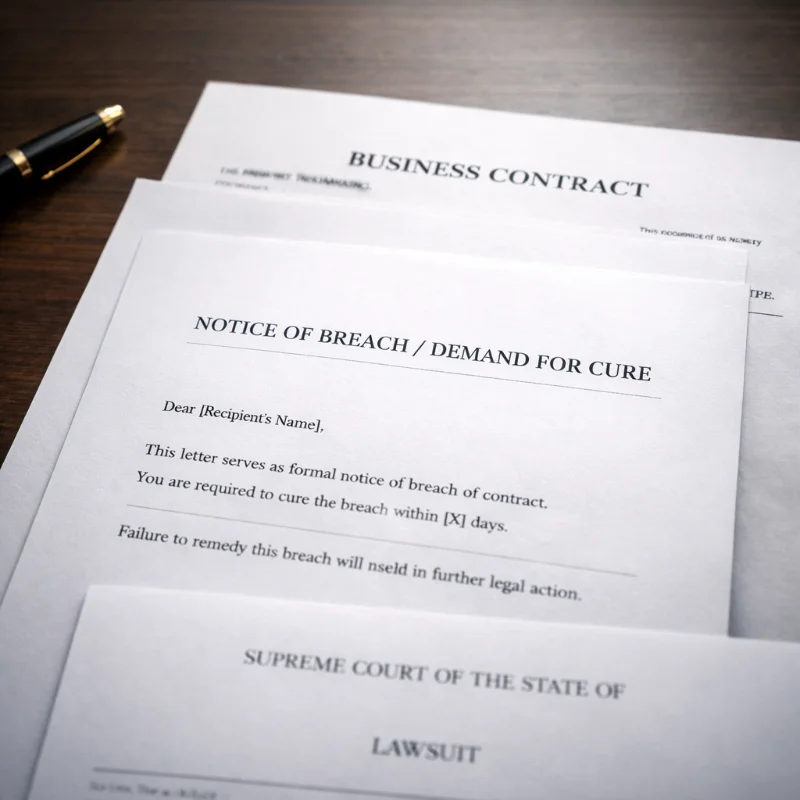
What Turns a Business Dispute Into Litigation

Business litigation begins when a dispute inside or around a company threatens control, revenue, or contractual rights beyond what negotiation can contain. Companies in Brooklyn, Queens, Manhattan, and Staten Island reach that point sooner than owners typically anticipate. Whether a business drives the process or gets carried by it depends on whether an NYC business litigation lawyer was retained before the dispute took shape.

A business in active litigation carries costs that never appear on a legal bill. Court filings are public record, so lenders, vendors, and counterparties learn of the dispute and renegotiate from strength while it runs. Financial exposure compounds the longer the case continues, and decisions made in the earliest stages shape the ground the case gets fought on and frequently decide which remedies remain practically available.

Early counsel determines which of those options survive. That judgment turns on forum and posture: how the Manhattan Commercial Division, Kings County Supreme Court, and Queens County Supreme Court each schedule and manage these cases, whether an existing arbitration clause works for or against the party holding it, and whether the facts support an application for emergency relief before the other side moves assets.

Shareholder, Partnership and Business Disputes We Handle

Business Divorce

50/50 Deadlock Judicial Dissolution Forced Buyouts Valuation Disputes Minority Oppression

Business divorce covers the separation of co-owners in a closely held New York business: negotiated buyouts, the sale of an interest or the entire company, and litigation when the other side refuses fair terms. We represent majority and minority owners of corporations, LLCs, and partnerships on the exit itself and on what surrounds it, including control of the company, access to its books and records, and the price of the departing stake.

Continue Reading
50/50 DeadlockJudicial DissolutionForced BuyoutsValuation DisputesMinority Oppression

Shareholder & Partnership Disputes

Withheld Distributions Shareholder Agreement Breaches Derivative Actions Voting and Control Disputes Books and Records Demands

Shareholder disputes in a closely held New York corporation run from withheld distributions and blocked access to records through contests over voting power, board control, and the terms of the shareholders agreement itself. We represent minority holders enforcing their rights and majority owners defending management decisions, in direct claims, derivative actions brought on the corporation’s behalf, and negotiated resolutions short of court.

Continue Reading
Withheld DistributionsShareholder Agreement BreachesDerivative ActionsVoting and Control DisputesBooks and Records Demands

Breach of Fiduciary Duty

Self-Dealing Diverted Business Opportunities Misappropriation of Company Funds Competing Business Ventures Fiduciary Accountings

A fiduciary claim arises when a partner, officer, director, or managing member uses a position of trust for personal benefit at the company’s expense, through self-dealing, diverted opportunities, or funds moved without authority. We pursue these claims for New York businesses and co-owners who uncover the misconduct, and we defend owners and managers accused of it, in damages actions, accountings, and disputes over removal from management.

Continue Reading
Self-DealingDiverted Business OpportunitiesMisappropriation of Company FundsCompeting Business VenturesFiduciary Accountings

Business Debt & Guaranty Litigation

Personal Guaranty Enforcement Promissory Note Litigation Merchant Cash Advance Disputes Confessions of Judgment Business Loan Defaults

A personal guaranty converts company debt into the owner’s personal liability, which is why a business loan default frequently becomes a dispute about the guarantor rather than the borrower. Enforcement and defense turn on the scope of that guaranty, the validity of any confession of judgment supporting it, and whether an advance structured as a receivables purchase functions as a loan. Kleyman Law Group litigates both sides in New York.

Continue Reading
Personal Guaranty EnforcementPromissory Note LitigationMerchant Cash Advance DisputesConfessions of JudgmentBusiness Loan Defaults

Business Fraud & Tortious Interference

Fraudulent Concealment Fraudulent Conveyance Claims Tortious Interference with Contract Conversion of Business Assets Aiding and Abetting Fraud

Business fraud claims reach conduct that contract law cannot: concealed liabilities, falsified records, assets conveyed out of reach, and third parties who induced a counterparty to walk away from its obligations. We represent New York businesses pursuing fraud, conversion, and interference claims against insiders, competitors, and counterparties, and we defend companies and owners accused of the same conduct in court and in arbitration.

Continue Reading
Fraudulent ConcealmentFraudulent Conveyance ClaimsTortious Interference with ContractConversion of Business AssetsAiding and Abetting Fraud

Emergency Injunctions & TROs

Asset Freeze Orders Preliminary Injunctions Yellowstone Injunctions Prejudgment Attachment Business Lockout Relief

Applications for emergency relief in New York courts are heard on days’ notice, and the record assembled before that hearing generally determines the outcome, because the responding side has little time to build one. A temporary restraining order can freeze an account, reverse a lockout, or halt a lease termination while the claim proceeds. Kleyman Law Group files these applications and opposes those obtained against New York businesses.

Continue Reading
Asset Freeze OrdersPreliminary InjunctionsYellowstone InjunctionsPrejudgment AttachmentBusiness Lockout Relief

Contract & Commercial Disputes

Contract Breach & Enforcement

Nonpayment Claims Deficient Performance Service Agreement Disputes Wrongful Termination of Contract Breach of Contract Defense

A counterparty that stops performing forces a decision with consequences of its own, because continued performance can waive the breach while premature termination can convert the non-breaching party into the defendant. Kleyman Law Group pursues payment and damages for New York businesses, and defends companies accused of breaching agreements they had cause to stop honoring, across vendor, service, supply and distribution relationships.

Continue Reading
Nonpayment ClaimsDeficient PerformanceService Agreement DisputesWrongful Termination of ContractBreach of Contract Defense

Commercial Real Estate Disputes

Holdover Proceedings Good Guy Guaranty Disputes Purchase & Sale Disputes Specific Performance Actions Yellowstone Injunctions

Commercial real estate disputes in New York run from lease defaults and terminations through fights over possession, guaranty liability, and deals that fail before closing. We represent landlords, tenants, buyers, and sellers on both sides of these matters: holdover and possession proceedings, injunctions that preserve a tenancy while a default is litigated, guaranty enforcement, and actions to compel or undo a sale of commercial property.

Continue Reading
Holdover ProceedingsGood Guy Guaranty DisputesPurchase & Sale DisputesSpecific Performance ActionsYellowstone Injunctions

Construction Disputes

Mechanic’s Lien Claims Trust Fund Diversion Payment & Performance Bonds Construction Defect Claims Scope of Work Disputes

Construction disputes come down to what the contract covered, what was built, and who holds the money. We represent owners, general contractors, subcontractors, and material suppliers on New York projects: filing and discharging mechanic’s liens, claiming against payment and performance bonds, litigating defective work and disputed scope, and tracing project funds a contractor spent somewhere other than the job they were paid to fund.

Continue Reading
Mechanic’s Lien ClaimsTrust Fund DiversionPayment & Performance BondsConstruction Defect ClaimsScope of Work Disputes

Fraudulent Inducement & Misrepresentation

Undisclosed Litigation Rescission Claims Merger Clause Defenses Negligent Misrepresentation Inflated Revenue Claims

A deal induced by false statements gives rise to claims the contract itself does not contain. We represent New York businesses that signed based on revenue figures, pending litigation, or financial obligations that were overstated, understated, or never disclosed at all, and we defend sellers and counterparties accused of making them, in actions seeking rescission, return of what was paid, and damages the merger clause does not bar.

Continue Reading
Undisclosed LitigationRescission ClaimsMerger Clause DefensesNegligent MisrepresentationInflated Revenue Claims

Judgment Enforcement & Asset Recovery

Restraining Notices Information Subpoenas Bank Account Restraints Judgment Domestication Property Liens & Executions

Collection is a separate proceeding from the case that produced the judgment, and a debtor who would not pay before judgment rarely pays after one. Recovery turns on locating assets, restraining bank accounts, compelling sworn disclosure of income sources, and docketing liens against real property the debtor owns. Kleyman Law Group enforces judgments against corporate and individual debtors, and domesticates those entered outside New York.

Continue Reading
Restraining NoticesInformation SubpoenasBank Account RestraintsJudgment DomesticationProperty Liens & Executions

Where a New York Business Case Gets Decided

What is the Commercial Division, and does my case qualify?

The Commercial Division is a part of New York Supreme Court reserved for business disputes, and the monetary threshold is set county by county. In New York County it is $500,000, in Kings County $150,000, in Queens County $100,000, and in Bronx County $75,000. The figure counts compensatory damages only, excluding punitive damages, interest, and fees. Since March 2025, an action seeking only equitable relief must also clear it, measured by the value of what the suit protects.

The claim must also fall within defined commercial categories, covering breach of contract and fiduciary duty, fraud arising from business dealings, the internal affairs of business organizations, and restrictive covenants. Shareholder derivative actions and dissolution proceedings qualify without regard to the threshold at all. Others are barred no matter the amount, including suits to collect professional fees, lease disputes over rent alone, and judgment enforcement.

Does an arbitration clause force the dispute out of court?

New York courts enforce arbitration agreements in commercial contracts and will stay a court action filed in the face of one. What actually gets litigated is scope rather than validity: a clause covering disputes arising under an agreement is construed more narrowly than one covering disputes relating to it, which is why a fraud or fiduciary claim sometimes proceeds in court while the contract claim goes to a panel. That distinction is settled on the drafting.

The practical consequence arrives before any of that is briefed. Major arbitral rules now provide for an emergency arbitrator appointed before the merits panel is constituted, though those procedures do not reach every rule set or every agreement, and applying to a court in parallel does not by itself waive the right to arbitrate. Review after an award is more constrained, since a court can vacate only on narrow statutory grounds and a wrong result is not one of them.

Does the case belong in state court or federal court?

Most business disputes between New York companies stay in New York Supreme Court, because federal jurisdiction requires either a federal claim or diversity of citizenship. Diversity has to be complete, meaning no plaintiff shares a state of citizenship with any defendant, and the amount in controversy must exceed $75,000. A corporation is a citizen of both its state of incorporation and the state where it maintains its principal office.

The distinction matters because the two systems run differently. Federal courts in the Eastern District, covering Brooklyn, Queens, and Staten Island, and the Southern District, covering Manhattan and the Bronx, apply their own procedural rules, assign a single judge from filing through trial, and generally move on a firmer schedule. A defendant sued in state court can sometimes remove the case to federal court, and that decision carries a short deadline measured from service.

Do I have to sue in the county where the business operates?

New York permits venue in a county where one of the parties resided when the action was commenced, or in the county where a substantial part of the events giving rise to the claim occurred. That second option was added by amendment and gives a plaintiff a real alternative when the parties are spread across boroughs. A contract that fixes venue in advance is enforceable on motion, so the agreement controls the choice and should be checked before a county is selected.

A corporation resides, for venue purposes, in the county named in its certificate of incorporation rather than the county where it operates, so a company running a warehouse in Queens may reside in Manhattan and be sued there. Partnerships and individually owned businesses follow a different rule and reside both where the principal office sits and where the partner or owner actually lives. An improper county forfeits the right to select venue at all.

What happens after a business is served with a summons?

The response deadline runs from completion of service, and the method controls the length. Personal delivery to the defendant inside New York State starts a 20-day period. Service by any other route, including delivery to a person of suitable age with a follow-up mailing or service through the Secretary of State, gives 30 days, and substituted service adds ten days after proof is filed.

A defendant who fails to appear is in default, and the plaintiff can then move for judgment on the claims as pleaded without the defense ever being heard. Vacating a default requires showing both a reasonable excuse for the delay and a meritorious defense, a substantially heavier burden than answering on time. Corporations served through the Secretary of State frequently receive the papers late, so the response deadline governs the first conversation after service.

What To Do When a Dispute Is Already in Motion

Bank access has been cut off or statements stopped arriving

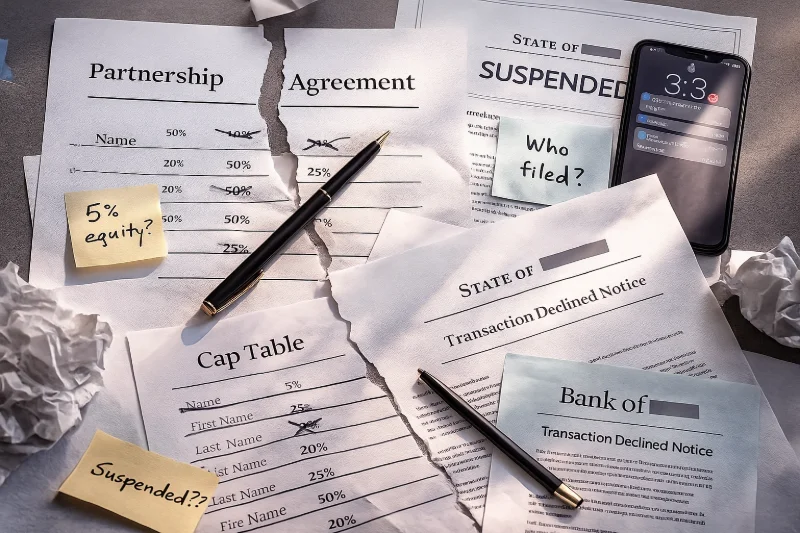
Control of the company's accounts determines which version of its finances is documented. Once revenue is routed to an account the other owner cannot see, tracing it becomes a forensic exercise rather than a document request. Statements, transfer records, and filed returns obtained while access is shared establish what the company reported before anyone had a reason to revise it.

New York gives owners a statutory right to inspect books and records, and a written demand starts the clock on that right whether or not the other side intends to honor it. A refusal is enforceable by proceeding. Where funds are actively moving, that demand runs alongside an application to freeze accounts. Asset diversion claims are built from what this window captures.

A co-owner is making decisions without your consent

Contracts signed, vendors replaced, and staff hired without approval raise the same threshold question: what the operating agreement, shareholder agreement, or partnership agreement actually required. Many closely held companies never executed one, or executed one that never addressed the conduct now at issue, in which case New York's default statutes supply the answer instead.

Owners who retaliate first, by changing locks, removing funds, or terminating the other side's access, frequently convert a strong position into the breach the other side pleads. The agreement, the entity records, and the pattern of prior conduct decide what is authorized, and entity type matters as much as the conduct. A business partner dispute attorney reads those first.

Equal owners cannot agree and the company cannot act

A lease that goes unsigned, a credit line the bank withdraws, and a position the company cannot fill are the evidence that a standoff has stopped the business rather than strained it. New York's default rules leave tie-breaking to a court, and the available outcomes differ sharply depending on whether the entity is a corporation or a limited liability company.

A petition converts an argument with no deadline into a proceeding with one, and it is regularly the point at which a counterparty who refused to discuss numbers begins discussing them. Both sides also face the same disclosure obligations once the proceeding opens, which changes what each is willing to accept. Business divorce is usually resolved by that pressure alone.

Request a Case Assessment

Send the agreement, the correspondence, and what the other side has done. We will tell you what claims exist, what deadline governs, and whether emergency relief is available before anything else is decided.

Questions Business Owners Ask

Bringing or Defending a Claim
Ownership Disputes
Protecting Your Position