New York Business Divorce

Forced Buyouts · Deadlock · Dissolution

Forced Buyouts, Deadlock, and Dissolution Between Co-Owners

A dispute between co-owners of a New York business raises three questions at once: who controls the company, what an ownership stake is worth, and who leaves. The answers were fixed the day the entity was formed. A minority shareholder holding 20 percent of a corporation can petition for dissolution, and that petition can end in a buyout at fair value elected by the company or the remaining shareholders. An LLC member holds no equivalent statutory exit; the operating agreement supplies the exit terms, and where it is silent, no forced-sale right exists. A partner in an at-will general partnership can dissolve it and force an accounting.

The governing documents decide most of what a court never reaches. A buy-sell clause fixes the exit price before anyone files. An arbitration clause moves the dispute out of court entirely. A clause defining a dissolution petition as an involuntary withdrawal can strip the filing owner of voting and management rights, converting the strongest remedy into a forfeiture. Kleyman Law Group reads these provisions before recommending any filing, because the agreement determines which remedies are safe to pursue.

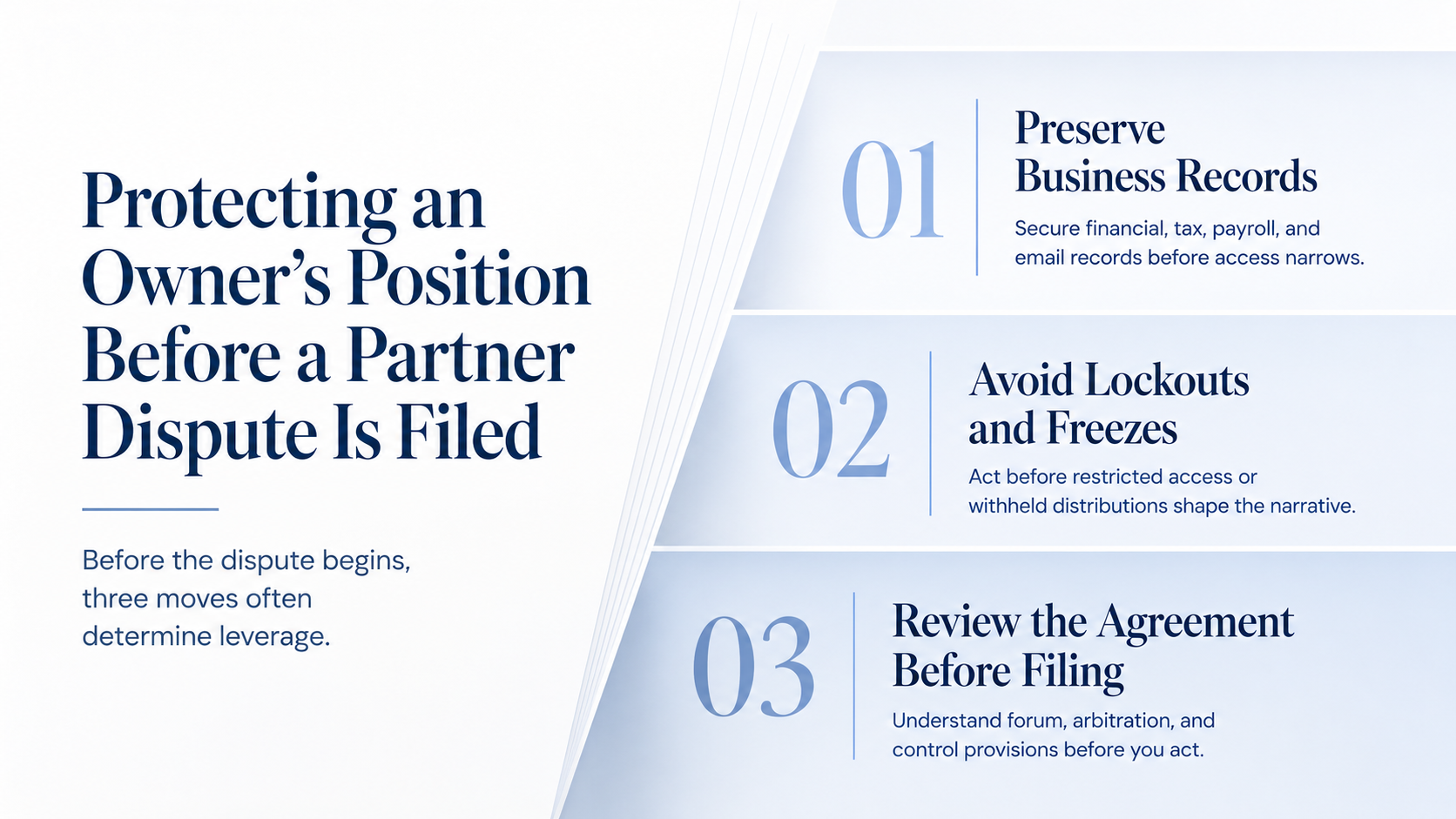
Position is built before the case starts. Company books, bank records, and email become harder to reach once the dispute is open, and the records an owner secures early are the evidence a freeze-out, deadlock, or diverted-funds claim is proven with. An owner who changes the locks or cuts off a co-owner's distributions supplies the other side its exclusion claim. The date a dissolution petition is filed fixes the date the company is valued.

Ownership Disputes Kleyman Law Group Handles in New York

Business Partner Stealing MoneyMisappropriated funds belong to the company, so the claim is generally derivative and recovery runs back to the business. Fiduciary claims for damages carry a three-year deadline, extended to six where fraud is essential. A judgment reaches the partner's personal assets, and compensation paid during the period of disloyalty can be forfeited. The firm litigates partner embezzlement and business fraud claims across Brooklyn, Queens, Manhattan, and Staten Island.

50/50 Partnership DeadlockA shareholder holding half the voting shares can petition for judicial dissolution on deadlock alone, without alleging misconduct, by showing division that threatens irreparable injury to the company. Neither path compels a buyout, so the exit price comes from the documents or negotiation. A buy-sell, shotgun, or appraisal clause generally controls the price and timetable in a 50/50 partnership deadlock.

Minority Shareholder Freeze-OutA shareholder holding at least 20 percent of a closely held corporation can petition for dissolution based on oppression, fraud, or waste, measured against the expectations held when investing. Within 90 days of filing, the corporation or remaining shareholders can elect to purchase the shares at fair value, and that generally irrevocable election converts the case into a valuation proceeding.

Breach of Fiduciary Duty by a PartnerWhere a transaction is self-interested, the business judgment rule generally does not protect it, and the burden shifts to the owner to prove the deal was entirely fair. A court can order disgorgement of profits, impose a trust on property bought with company funds, forfeit compensation paid during the disloyalty, and enjoin conduct that is ongoing. Damages claims carry a three-year deadline, six where fraud is essential.

Operating Agreement ViolationsCapital calls, voting thresholds, transfer restrictions, and buyout triggers are enforced as written, and courts read them strictly. Breach claims generally carry a six-year deadline. Where money cannot repair the harm, specific performance or an injunction is available, and where the agreement is silent, statutory defaults allocate control differently than owners assumed. The governing clause determines the demand in an operating agreement dispute.

Majority Owner MisconductA majority owner owes fiduciary duties to the minority, and courts examine the financial conduct: salary drawn while distributions are withheld, self-dealing leases, dilution through a capital call the minority cannot fund, and termination of employment that was part of the investment return. The relief includes damages, a court-supervised buyout at fair value, and judicial dissolution.

Entity Type Decides Which Remedies Exist

A 20% Petition Forces a Buyout

A shareholder holding at least 20 percent of the voting shares of a closely held New York corporation can petition to dissolve it for oppression, looting, or waste. Within 90 days of that filing, the corporation or the other shareholders can elect to buy the petitioner's shares instead, at fair value fixed as of the day before the petition. Fair value is set without a minority discount.
LLC Exit Follows the Agreement

New York gives LLC members no statutory oppression remedy. Dissolution requires proof that management cannot or will not permit the company's stated purpose to be met, or that continuing the company is financially unfeasible. Expulsion, exclusion from management, and withheld distributions generally fail that standard. No statutory buyout exists, so an exit price comes from the operating agreement or from negotiation.

Any Partner Can Dissolve At Will

A partner in a general partnership with no fixed term can dissolve it at any time by expressing that intent. Dissolution starts a winding up, the partnership survives until the accounts are settled, and each partner can demand a formal accounting. Partners also stay personally liable for partnership debts incurred before dissolution, which shareholders and LLC members are not.

Minority Shareholder Rights and Oppression Claims

A Books and Records Demand Forces Disclosure

A shareholder who has held shares of record for six months, or who owns at least five percent of a class, can demand inspection of the minutes and shareholder list, and courts compel production of financial records where a proper purpose is shown. A refusal to produce company records becomes evidence.

Derivative Claims Belong to the Company

Harm to the company is a derivative claim brought on its behalf, and any recovery returns to the entity rather than the owner. Harm unique to one owner is direct. Pleading a derivative claim as direct is a routine ground for dismissal, and courts look at who was injured, not at the label used.

Oppression Turns on Reasonable Expectations

Shareholder oppression is measured against the expectations the shareholder held when investing, viewed objectively. Termination of employment, removal from management, and cutting off distributions qualify where they defeat those expectations. Disagreement with ordinary business decisions does not.

Freeze-Outs Precede the Lowball Buyout Offer

Freeze-outs run in sequence: distributions stop while the majority keeps drawing salary, information is restricted, the minority loses its role, and a below-value offer follows. Documenting that sequence before the offer arrives determines what the owner can demand once it does.

A Deadlock Petition Cannot Compel a Buyout

A 50 percent shareholder can petition for dissolution on deadlock, but no court can compel either side to buy the other out. A shareholder deadlock petition ends with dissolution granted or denied. The statutory buyout election exists only in oppression proceedings, which changes how a deadlocked owner files.

A New Venture Can Be a Diverted Opportunity

An owner who takes a business opportunity within the company's line of business must generally offer it to the company first. Where the opportunity is diverted in breach of fiduciary duty, courts can impose a trust on the profits and on the competing entity. Formation records and customer overlap prove the diversion.

Forced Buyout, Injunction, and Dissolution Remedies Compared

Preserve the Business Force the Exit

Negotiated Partner Buyout

Where the governing documents contain a buy-sell, shotgun, or appraisal clause, that clause generally controls the exit price and the timetable. Filing a petition fixes the valuation date and puts the schedule in the court's hands.

Emergency Injunctive Relief

A preliminary injunction requires likelihood of success, irreparable harm, and a balance of the equities. It preserves accounts and records while the case proceeds, and it carries a mandatory bond. It cannot freeze assets on a pure money claim; pre-judgment attachment is the separate device for that.

Forced Buyout at Fair Value

The statutory buyout election exists only in corporate oppression cases: within 90 days of the petition, the company or any shareholder can elect to purchase the shares at fair value. In every other posture a buyout arrives by agreement or as equitable relief.

Judicial Dissolution

Courts grant dissolution sparingly. A corporation can be dissolved for deadlock or oppression, an LLC only where its stated purpose cannot be achieved or continuing the business is financially unfeasible. The endpoint is liquidation, and in a 50/50 deadlock no court can compel either owner to buy the other out.

Talk through your options before you act: preserve the records, protect your leverage, review the path forward.

Talk Through Your Options Before You Act

Whether you are being pushed out, blocked from company records, or weighing a buyout or dissolution, the first move usually decides the outcome. Kleyman Law Group reviews the situation and lays out the paths.

How Fair Value Is Determined in a New York Buyout

01

Fair Value Is the Full Share, No Minority Discount

Fair value in a New York buyout is the owner's proportionate share of the business as a going concern. Courts prohibit a minority discount, so a 30 percent interest is worth 30 percent of the whole, not a lack-of-control fraction of it. A discount for lack of marketability is permitted but not required, and courts have refused it where the majority never intended to sell.

02

Value Is Set the Day Before the Petition Is Filed

When the buyout election is made, fair value is measured as of the day before the dissolution petition was filed, excluding any change in value the filing itself caused. The date is fixed by the filing, not by the trial, so appreciation or decline during years of litigation belongs to whichever side the date favors.

03

Appraisers Normalize the Books First

Appraisers normalize the historical financials before valuing them, because tax returns understate what a closely held business earns. Owner compensation is restated to market rates, personal expenses run through the company are added back, and above- or below-market rent paid to owner-affiliated entities is corrected.

04

Misconduct Raises the Price Through Surcharges

The court can adjust the valuation or impose a surcharge where those in control wasted, looted, or diverted company assets, so proven misconduct raises the buyout price directly. Interest generally runs from the filing date to payment at an equitable rate the court sets in its discretion. The hearing is expert-driven, and the court may adopt neither side's number.

Defending a Dissolution or Oppression Petition in New York

The Buyout Election Ends the Case in 90 Days

A corporation or its remaining shareholders can respond to an oppression petition by electing to purchase the petitioner's shares at fair value. The election is generally irrevocable, ends the dissolution threat, and converts the entire case into a valuation proceeding.

The Business Judgment Rule Protects Good-Faith Calls

Ordinary management decisions made in good faith and without self-interest are generally protected from second-guessing, and the protection is proven with contemporaneous records: board minutes, market compensation data, and documented business reasons. The protection falls away where the decision benefited the decider, so those transactions need separate justification.

A Demand Letter Sets Deadlines You Must Answer

A demand letter or served petition starts clocks: the answer is due shortly before the return date the petition sets, not on a fixed count of days after service, and the 90-day election window in an oppression case runs from the filing of the petition. A default judgment can result, which becomes an enforcement problem for the owner served.

Who Pays the Legal Fees in an Ownership Dispute

Advancement Pays Defense Costs During the Case

Indemnification reimburses an owner after the case ends. Advancement pays the legal bills as they are incurred, which decides who can afford to litigate. New York law permits a company to do both but requires neither, so the right comes from the operating agreement, the bylaws, or a board or shareholder resolution. Advancement is generally conditioned on a written undertaking to repay if indemnification proves unavailable.

Generic Indemnity Covers Only Outside Claims

Courts read indemnification clauses as covering claims brought by outsiders unless the language makes it unmistakably clear that it also reaches suits between the owners themselves, and broad boilerplate does not meet that bar. The consequence in a business divorce is direct: a controlling owner may fund a defense from company accounts while the minority pays counsel personally, and that asymmetry shapes the settlement.

A Court Can Stop Company-Funded Defense

Indemnification is barred where a final adjudication establishes that the owner acted in bad faith, acted with deliberate dishonesty, or gained a financial advantage to which they were not entitled. Advancement can be enjoined before that point where the agreement allows only post-judgment indemnification, or where the evidence shows the owner is dissipating the assets that would satisfy a judgment against them.

What the Litigation Costs the Company While the Case Runs

A Receiver Can Take Control of Operations

A court can appoint a temporary receiver where company assets are in danger of being lost or dissipated. The appointment order fixes the receiver's powers, which can include operating the business, collecting receivables, and selling assets. The receiver posts an undertaking, reports to the court, and is entitled to a commission of up to five percent of the money received and disbursed, paid out of company funds.

Filing Can Trigger an Involuntary Withdrawal

Some operating agreements define the filing of a dissolution petition, or a request for a receiver, as an involuntary withdrawal event that strips the filing member of voting rights and converts the interest into a passive economic stake. The agreement decides this question, and it is read before the petition is drafted.

Creditors Gain Rights Once the Dispute Is Public

Creditors can petition to have their claims determined inside a pending dissolution proceeding and can ask the court to appoint a receiver over the company. Credit agreements commonly treat the appointment of a receiver, or the commencement of a dissolution proceeding, as an event of default that accelerates the loan and pulls the lender into the fight.

Business Divorce Advice Before the Dispute Gets More Expensive

Deadlock, forced buyout, and ownership disputes are easier to manage before positions harden and the company starts losing value.

Frequently Asked Questions

Cost tracks the remedy sought. A books and records proceeding is the least expensive path. A negotiated buyout costs more but avoids expert valuation fees. A contested fair value hearing is the most expensive posture, because each side retains a business appraiser and expert fees can exceed the legal fees.

Emergency applications for a temporary restraining order are heard within days. A dissolution petition is a special proceeding and moves faster than an ordinary action, but once a buyout election converts the case into a valuation contest, discovery and expert work extend the timeline. Many disputes resolve once the valuation ranges are exchanged and each side sees the other's number.

Most are. Where the operating agreement contains a buy-sell, shotgun, or appraisal clause, that clause supplies the mechanism and no filing is required. Mediation resolves many disputes where both owners still want the business to survive. An arbitration clause is enforced as written, and the arbitrator's award is generally final and subject to only narrow judicial review.

Bank statements, vendor invoices, payroll records, credit card statements, and general ledger entries establish what left the company and when. Related-party transactions, vendors traced back to the partner, and personal expenses run through the company are the common patterns. A forensic accountant reconstructs the trail, and suspicion unsupported by documents rarely survives a motion to dismiss.

Yes. A shareholder who has held shares of record for six months, or who owns at least five percent of a class, can serve a written demand to inspect the minutes and the shareholder list, and courts compel production of financial records where a proper purpose is shown. LLC members have narrower statutory inspection rights under the LLC Law, tied to records the company must keep and to a purpose reasonably related to their membership interest.

Breach of fiduciary duty claims seeking money damages generally carry a three-year deadline, extended to six years where fraud is an essential element or where equitable relief is sought. Breach of contract claims, including claims under an operating or shareholder agreement, generally carry six years. The fiduciary clock ordinarily runs from the wrongful act, while a fraud claim can run from when the fraud was discovered or should have been discovered.

Preserve every document before responding, since discovery reaches both sides. Calendar the response deadline and the ninety-day election window immediately. Evaluate whether electing to purchase the petitioner's shares at fair value is preferable to litigating the oppression allegations, because that election is generally irrevocable and ends the dissolution claim while converting the case into a valuation proceeding.

Ordinary management decisions made in good faith and without self-interest are generally protected from judicial second-guessing. The protection is established with contemporaneous records rather than testimony: board minutes, market compensation data, and documented business reasons. It does not extend to self-interested transactions, which require separate justification of their fairness to the company.

Yes. A judgment for breach of fiduciary duty runs against the owner personally and reaches personal assets, not merely the equity stake. Compensation paid to a disloyal owner during the period of disloyalty can be forfeited on top of the amounts taken, and profits from a diverted opportunity can be disgorged. Punitive damages are available where the conduct is sufficiently egregious.

Venue generally follows the company: Kings County Supreme Court for a Brooklyn business, Queens County for Queens, New York County for Manhattan, and Richmond County for Staten Island. Dissolution proceedings and shareholder derivative actions are assigned to the Commercial Division without regard to its monetary thresholds, so these cases generally qualify for a Commercial Division judge.

Yes. New York gives corporate shareholders an oppression remedy, but LLC members have no statutory oppression remedy. Dissolution of an LLC requires proof that management is unable or unwilling to permit the company's stated purpose to be achieved, or that continuing the business is financially unfeasible. Exclusion from management and withheld distributions generally fail that standard on their own, which makes the operating agreement decisive.

The mechanics differ from ordinary commercial litigation. The buyout election, the valuation date, the discounts a court will and will not apply, and the interaction between deadlock and oppression petitions all shape outcomes before the merits are reached. Kleyman Law Group handles ownership disputes for both petitioners and respondents in Brooklyn, Queens, Manhattan, and Staten Island.