How to Prove a Breach of Contract Claim in NY
The Four Elements
Every breach of contract claim in New York rises or falls on four elements. The plaintiff has to prove each one with specific facts in the complaint. The defendant only has to defeat any one of them to win on a motion to dismiss. A signed contract and unpaid invoice are not enough.
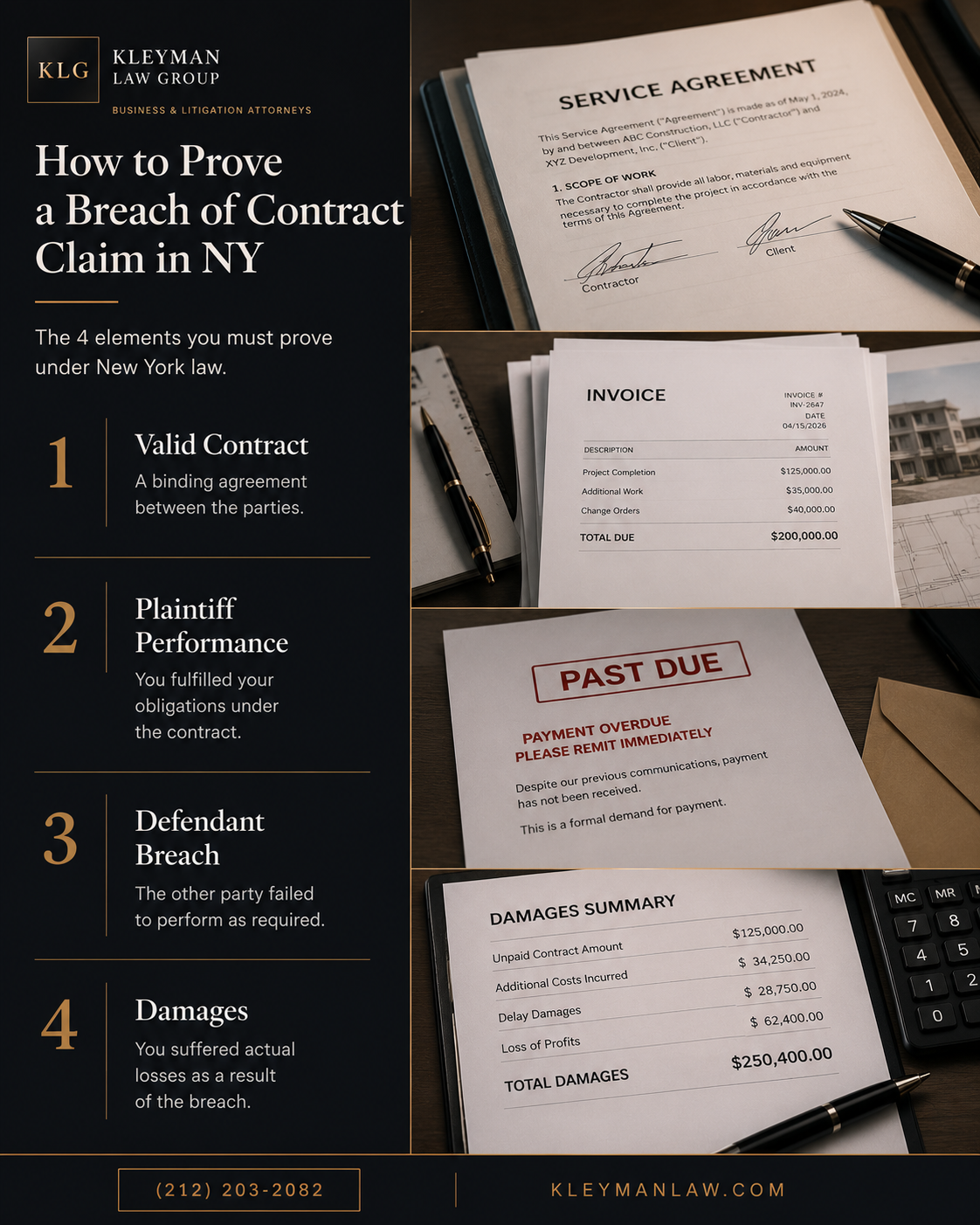
The visual at right shows the order a New York court actually evaluates these cases in practice. Element by element, the framework moves from formation to performance to breach to damages. A motion to dismiss can be granted on any element not plausibly pleaded under CPLR 3211(a)(7).
Use the framework as a checklist before filing. The gaps in any of the four elements are where opposing counsel will press the early motion to dismiss. Strong cases are built before the complaint is drafted, not after, and the sections below cover each element with the required proof.
A Valid Contract Existed
A valid New York contract requires three things: an offer, an acceptance of that offer, and consideration. Consideration means each side gave up something of value to the other. Without all three the agreement is not enforceable, and any breach claim collapses before the first hearing. A written, signed contract makes this element easy to prove.
Oral contracts are enforceable in New York, but the proof problem is steeper. Courts look for emails confirming terms, payment records, partial performance, and witness testimony. The stronger the record of both sides acting as if a deal existed, the stronger the inference of agreement. See our guide on verbal contracts in New York for analysis.
Certain contracts have to be in writing to be enforceable in New York. The Statute of Frauds at General Obligations Law § 5-701 covers contracts for the sale of real property, promises to pay another person's debt, agreements that cannot be performed within one year, and contracts for the sale of goods over $500 under the UCC. If the agreement falls into one of these categories and was never written down, the claim is dead before the first hearing.
The complaint has to plead a prima facie case for each element. That means specific facts: when the contract was formed, what each side promised, what consideration was exchanged. Vague references to a "deal" or an "understanding" get dismissed under CPLR 3211(a)(7). Read more on formation in what makes a contract legally binding in New York.
One issue catches owners off guard: privity. You can only sue someone who was a party to the contract. If Company A is your counterparty and its affiliate Company B is the one that actually failed, Company B is outside your reach unless it took on the obligation expressly. Brooklyn, Queens, Manhattan, and Staten Island courts apply this strictly.
You Performed Your Side
Before the other side is held to account, the plaintiff has to show it did what the contract required. New York courts take this seriously. In a suit over a contractor who walked off the job, the defendant's first move will be to point out any progress payment the plaintiff missed. The order of operations decides who is the breaching party.
Performance does not have to be perfect. The doctrine of substantial performance covers core duties met with minor shortfalls. New York also excuses performance when the defendant blocked it or when the duty was a condition precedent the defendant never triggered. The strength of the documentary record decides which side wins each argument.
The Other Side Failed
The third element is straightforward in concept and contested in practice. The plaintiff must prove the other side did not do what the contract required, and that the failure was material. Material breach goes to the heart of the contract; a minor breach lets the plaintiff sue for the shortfall but does not free either side from the rest of the deal.
Anticipatory breach lets the plaintiff act before the performance date arrives. If the other side communicates unequivocally that it will not perform, the contract is treated as broken. New York courts require a positive and unequivocal repudiation. Hedge words, conditional refusals, vague signals of trouble, and ambiguous statements do not qualify.
New York courts evaluate materiality through a framework drawn from the Restatement (Second) of Contracts. Courts weigh how much benefit the non-breaching party was deprived of, whether money damages can fully replace it, the extent of forfeiture the breaching party faces, the likelihood the breach will be cured, and whether the breaching party's conduct reflects good faith and fair dealing. No single factor decides the analysis.
Every New York contract carries an implied covenant of good faith and fair dealing. The covenant blocks a party from undermining the other side's right to receive the benefit of the bargain. It does not rewrite the deal, but it runs alongside the express terms and creates a parallel claim where the conduct is bad-faith despite technical compliance.
One procedural point decides motions early: the complaint has to identify the specific contract provision that was breached. New York appellate courts dismiss claims that allege breach in general terms without pointing to particular contract language. A breach of contract lawyer in NYC will identify the exact provision before drafting the complaint.
The Breach Caused Damages
Proving the breach is not enough. The plaintiff must show measurable financial harm caused by the breach. New York will not award damages on speculation. The standard is reasonable certainty, with financial records, invoices, replacement contracts, and a damages model tying losses to the breach. These numbers fail on summary judgment motions.
The default measure is expectation damages. The award puts the plaintiff in the financial position it would have been in if the contract had been performed. If a supplier failed to deliver $50,000 of inventory and replacement cost $58,000, direct damages start at the $8,000 difference plus any costs of cover, minus expenses the plaintiff saved.
New York courts require that damages be proven with reasonable certainty. Mathematical precision is not required, but the record has to give the court a stable basis for the number. Financial statements, invoices from replacement vendors, profit-and-loss data tied to historical performance, and expert testimony where losses are complex form the building blocks of a damages case that survives a summary judgment motion.
New York recognizes four core categories of contract damages and one limiting doctrine that constrains them all. Each carries its own evidentiary burden, and each is the subject of its own fight in commercial litigation. The cards below summarize what each type covers, what proof New York courts demand, and where each wins or loses in practice.
Expectation Damages
Also called direct damages: the benefit of the bargain. The amount needed to put the plaintiff in the position performance would have produced. This is the standard award in New York contract litigation.
Consequential Damages
Indirect losses flowing from the breach, like lost profits. Recoverable only when both sides could foresee them at contract formation. The New York proof bar is high; proof needs solid financial records.
Liquidated Damages
Damages set by the contract itself. Enforceable when the amount is a reasonable forecast of harm at signing and actual damages would be hard to calculate. Courts strike clauses that look like penalties.
The Duty to Mitigate
New York requires the non-breaching party to take reasonable steps to limit losses after the breach occurs. Failure to mitigate cuts the recovery. Document every mitigation effort, even ones that fail.
For a deeper look at what business owners collect after winning, see what you can recover for breach of contract in New York. Punitive damages are almost never available in pure contract cases. The narrow exception requires conduct tortious in nature, directed at the public generally, and morally culpable. New York courts set that bar very high.
Have Your Case Reviewed
Free 30-minute case review. Brooklyn, Queens, Manhattan, Staten Island.
What Kills a Strong Claim
The fastest way a strong-looking case dies is at the pleading stage. A complaint that describes the breach in broad terms without identifying the specific contract provision violated invites a CPLR 3211(a)(7) dismissal before discovery begins. New York courts read complaints strictly and require the contract language tied to the alleged failure, the date of the breach, and the obligation the defendant did not perform. A plaintiff who alleges only that the defendant "breached the agreement" faces a motion to dismiss on the first appearance. The remedy is precision before filing, which is where a contract attorney in NYC earns the fee.
The second category of self-inflicted wounds involves the plaintiff's own performance record. New York requires the plaintiff to plead and prove that it did its part before the breach occurred. A defense attorney looks for any payment that was late, any deliverable that fell short, and any obligation that came due before the alleged breach and was missed. Even small gaps get framed as prior material breach or unclean hands. Plaintiffs with payment records, signed change orders, and inspection sign-offs survive these attacks; without that documentation, a strong case gets pushed into bad settlements or lost at summary judgment.
The third killer is on the damages side. A plaintiff can win every other element and walk away with nothing because the damages were not proven with reasonable certainty. New York rejects speculative numbers without a documented foundation. Lost-profit claims need historical financial data tied to the same line of business. Consequential damages require proof both sides foresaw the loss at signing. The damages model has to be built before filing, not assembled during discovery. A team that handles business litigation in New York treats damages proof as a first-stage problem, not an afterthought, and ties every number to documented records.
The Procedural Reality
Where the suit is filed shapes the timeline and cost. New York City Civil Court handles contract claims up to $50,000 in 2022 and onward. Above that, the case goes to the state Supreme Court in the county of jurisdiction. The Commercial Division within Supreme Court takes commercial cases that meet monetary thresholds set by 22 NYCRR § 202.70: $500,000 in New York County, $150,000 in Kings, and $100,000 in Queens. Federal court is an option when the parties are citizens of different states and the amount in controversy exceeds $75,000.
New York's statute of limitations on breach of contract is six years under CPLR § 213(2). Sales of goods under the Uniform Commercial Code Article 2 have a four-year limit set by UCC § 2-725. The clock starts at the date of the breach, not the date the plaintiff learned about it. A plaintiff who waits past the deadline loses the claim entirely, no matter how strong the underlying facts. Tolling is narrow in commercial contract cases, with exceptions limited to fraud-based claims. Full analysis on the CPLR § 213(2) deadline sits in our SOL piece.
A well-drafted demand letter routinely produces a faster resolution than a lawsuit. The letter signals seriousness, locks in the plaintiff's account of the dispute, and gives the other side a window to settle before costs mount. New York courts treat demand letters as evidence of good faith if the case proceeds. Plaintiffs who skip this step lose negotiating room and pay more in attorney's fees during the early procedural skirmishes. The letter creates a record the other side cannot pretend never happened. See our guide on the demand letter for drafting.
Frequently Asked Questions
Build the Case. Recover the Loss.
Kleyman Law Group represents business owners in contract disputes across Brooklyn, Queens, Manhattan, and Staten Island.