Defenses to a Breach of Contract Claim in New York
The arguments New York courts accept against enforcement, from formation challenges to procedural defenses.
Read ArticleWhether a legally binding contract was ever formed is a threshold question in New York commercial litigation, resolved before a court reaches the question of who breached what. A defendant who establishes that no enforceable agreement existed generally defeats the breach claim outright, along with the expectation damages that would have followed from it, leaving the performing party to pursue equitable theories that recover far less.
Formation becomes contested where the parties dealt informally. Terms move across an email chain instead of one executed document, performance begins while the other side is still revising a draft, and payment follows an invoice rather than a signature. New York courts generally weigh those facts against the full record of the transaction, and the same email chain can establish a contract in one case and defeat one in another.
The governing standard is objective. What a New York court measures is what the parties outwardly said, wrote, and did, giving no weight to what either side later claims it privately intended. That standard puts the documentary record at the center of nearly every formation dispute, and it is the reason a business can become bound to terms it never signed.
A New York court asks whether the parties objectively manifested an intent to be bound, measured by what they said, what they wrote, and what they did. The label on a document carries little independent weight. An agreement titled "Memorandum of Understanding" can bind its signers, and one captioned "Contract" can fail for want of agreed essential terms.
Formation requires an offer, acceptance, consideration, mutual assent to the essential terms, and intent to be bound. Two further requirements apply to every agreement and defeat it when absent. Each party must have legal capacity to contract, meaning age of majority and sufficient mental competence to understand the obligation being undertaken. The contract's purpose must also be lawful; New York courts generally decline to enforce an agreement whose subject matter is illegal, and they will not rewrite it into a lawful one.
Courts generally assess these requirements against the whole transaction rather than element by element: the sequence of communications, the performance that followed, and the commercial expectations both sides acted on. An agreement can be enforceable though no participant ever used the word contract. Months of negotiation can also produce nothing enforceable where the parties never fixed the terms a court would need to enforce.
Intent to be bound decides most New York formation disputes, and it is established through evidence rather than assertion. A party claiming a contract exists has to point to something in the record that shows commitment. A party denying one has to account for conduct that looks like performance.
Intent is assessed at the time of the alleged agreement rather than at the time the dispute surfaced. A party that treated a deal as closed for months and repudiated it only after conditions changed generally cannot recharacterize that earlier conduct as continuing negotiation.
The useful evidence is therefore contemporaneous, meaning what the parties wrote while the relationship was working rather than what either says about it once counsel is involved. Internal records carry weight for the same reason. A budget approval, a resource assignment, or an accounting entry booking the deal can establish that a party regarded itself as committed, even where it took the opposite position after the dispute began.
Conditional language such as "subject to contract" or "pending definitive agreement" is generally effective where it reflects a real reservation and the parties act accordingly. Its force depends on that consistency. Transferring funds, delivering goods, or integrating operations while the disclaimer is nominally in place undercuts it, and New York courts generally credit the conduct over the caption.
A reservation of the right not to be bound protects a party only while its own conduct stays consistent with that reservation.
A reservation holds up best where it appears in the operative document rather than a cover email, where neither side performs before execution, and where everyone negotiating takes the same position throughout. It fails most often where one party accepts a benefit under the deal while continuing to describe the deal as unsigned.
A contract can be enforceable with nothing signed, provided the parties agreed on the essential terms, consideration moved in both directions, and the agreement falls outside the categories New York requires to be in writing.
Where those conditions are met, the absence of a document does not defeat the agreement. The difficulty is evidentiary: the party seeking enforcement carries the burden of proving what was agreed without the document that would ordinarily settle it, so the claim survives or fails on what corroborates it.
Invoices. A document stating the alleged price, sent while the relationship was intact and before either side had reason to characterize the deal.
Delivered work. Performance matching the alleged scope, which shows what both sides understood the agreement to require of them.
Payment history. Sums accepted over time without objection, corroborating the price, the payment term, and the fact of an agreement.
Written messages. Texts or emails recording the terms contemporaneously, rather than correspondence generated after the falling-out.
Where schedules outrun documentation, one side routinely performs while a New York contract attorney is still revising the draft. When the relationship fails, the party resisting enforcement argues that the unsigned draft proves negotiations never closed. New York courts generally reject that argument where conduct shows agreement on the material terms, treating the draft as evidence of what was agreed rather than proof that nothing was.
Partial performance strengthens an unwritten claim only where the conduct makes sense on no other explanation. A supplier that ships goods manufactured to one buyer's specification has done something continued negotiation does not account for. Conduct equally consistent with an ongoing courtship carries little weight, which is why the same category of evidence decides some formation disputes and is disregarded in others.
Unwritten claims fail most often for reasons that have nothing to do with credibility. The parties never fixed a price or a completion date, so a court has no term to enforce. The corroborating documents postdate the falling-out and read as position-taking. The performance relied on is equally explicable as preparation. And where the agreement falls inside one of the categories covered next, corroboration does not cure the missing writing.
The categories below are the exception to everything above. New York's Statute of Frauds, at General Obligations Law § 5-701 and § 5-703, requires a signed writing for defined categories of agreement, and an oral deal falling inside one of them is generally unenforceable however clearly the parties assented. Courts construe the categories narrowly, applying them where an agreement plainly falls inside and declining to extend them by analogy.
Any agreement that by its terms cannot be fully performed within one year of formation. Courts read this narrowly, asking whether completion within a year is possible, not whether it is likely, so most at-will and open-ended arrangements fall outside it.
A promise to answer for the debt or default of another person must be signed and in writing. The provision reaches informal commitments to stand behind a partner's obligation or a related company's loan, which is where it most often surprises.
Compensation for negotiating a business opportunity, including the sale of a business or an interest in real property, requires a writing. Handshake referral arrangements between professionals fail here more than anywhere else in the statute.
Contracts to sell real property and leases running longer than one year must be in writing. The categories are enforced strictly, though partial performance unequivocally referable to the agreement can take an oral deal outside the statute.
Goods contracts at or above $500 require a signed writing. Between merchants, a written confirmation of an oral deal that goes unobjected to within ten days satisfies the requirement, an exception that decides many commercial disputes.
The categories share a theme: long commitments, other people's obligations, land, and significant goods. Routine service arrangements between businesses generally fall outside all of them, which is why most oral commercial deals are enforceable.
Two exceptions carry the most practical weight. Partial performance can remove an agreement from the statute where one side has materially relied on it, most often in real property and personal services. And under the federal E-Sign Act and New York's Electronic Signatures and Records Act, electronic correspondence containing the material terms satisfies the writing requirement, with the signature element met by a typed name, an email signature block, or any symbol adopted with intent to authenticate. The practical effect is that the email exchange described above can satisfy the statute it appears to violate.
An exchange of emails can satisfy the Statute of Frauds and form a binding contract with no signed agreement anywhere in the file. New York courts have enforced compensation arrangements, options on real property, and commercial sales terms on correspondence alone. The substantive requirements do not change in email form. Offer, acceptance, consideration, definite material terms, and intent to be bound must all appear, and a court will assemble them across multiple messages in a thread, provided the messages describe the same bargain. What email formation turns on, beyond the ordinary elements, is two requirements specific to the medium.
The exchange has to establish who is contracting with whom. Business email domains, signature blocks, and references within the thread generally settle identity, and New York courts have rejected challenges built on the absence of formal party designations where the context left no ambiguity. The issue becomes live where deals are negotiated through intermediaries or personal accounts, since the record then has to connect the sender to the party to be charged.
Under the federal E-Sign Act and New York's Electronic Signatures and Records Act, the signature requirement is satisfied by a typed name, a signature block, or any symbol adopted with intent to authenticate. A name typed at the foot of an email, combined with the sending address, is generally sufficient. The requirement does real work in one situation: an automatically appended signature block, standing alone, is weaker evidence of intent to authenticate than a name typed deliberately, and parties resisting enforcement raise exactly that distinction.
Every email that negotiates commercial terms is potentially one component of an enforceable agreement. A party intending to remain uncommitted has to say so in the correspondence itself, since a reservation appearing nowhere in the record is difficult to establish once the deal is disputed. A party intending to commit should recognize that formation can occur weeks before anyone circulates a signature page.
New York courts generally decline to enforce an agreement to agree, meaning an arrangement in which the parties settled some terms and left essential ones for future negotiation. A statement that the parties will finalize details later leaves nothing to enforce where price, scope, or duration was never fixed, because a court has no standard against which to measure performance.
The definiteness requirement is applied with restraint. Where the parties clearly intended to be bound and a missing term can be supplied from an objective source, such as a market rate, an industry standard, or the parties' own course of dealing, New York courts generally supply the term and enforce the bargain. Voiding an agreement as indefinite is treated as a last resort. The doctrine protects parties who documented their material terms and offers nothing to parties who documented none.
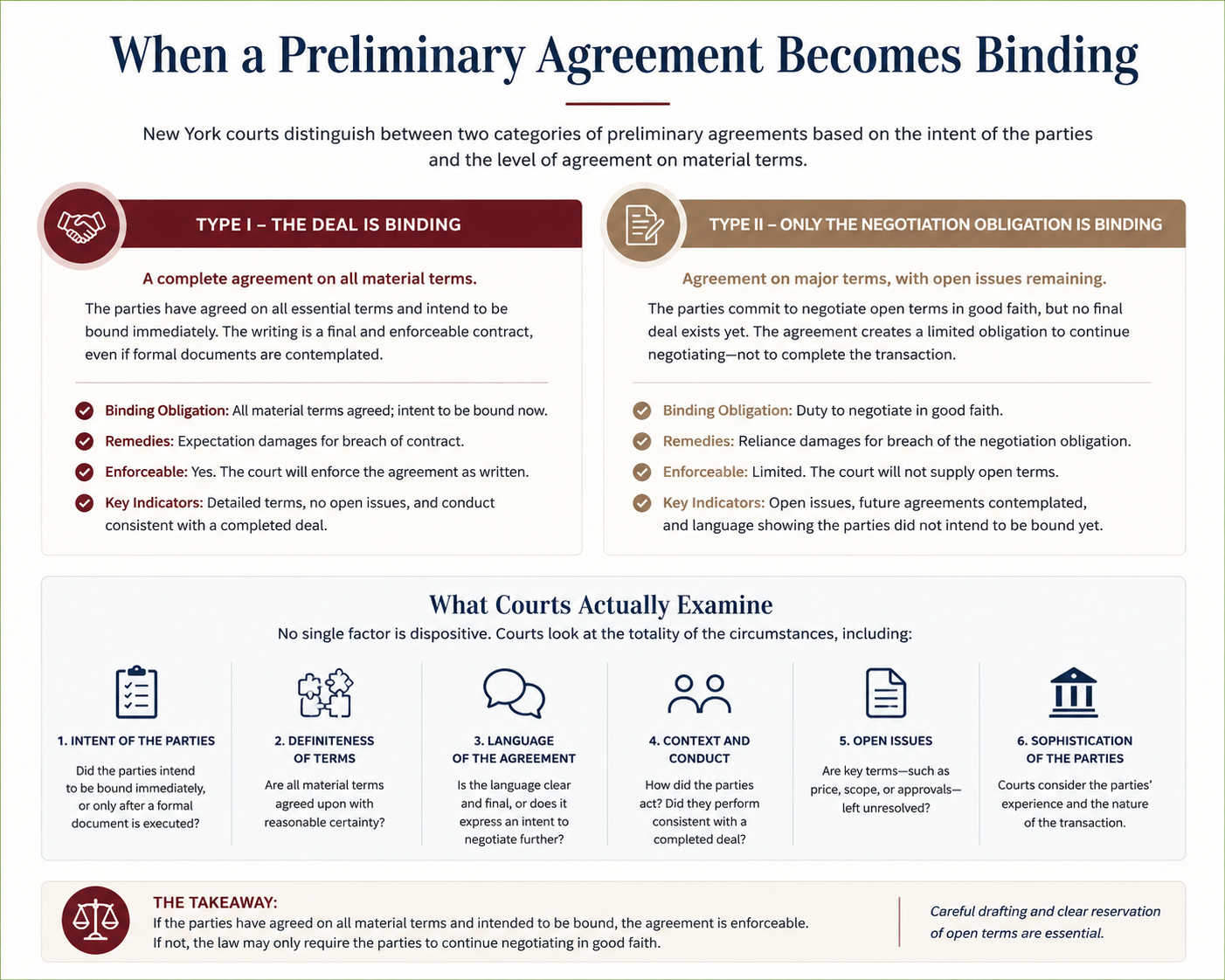
A preliminary writing is assessed on its contents and on how the parties behaved after signing, and the caption at the top carries no controlling weight. Where every material term is settled, the writing can be immediately enforceable, and a party that walks away faces expectation damages. Where major terms are agreed and defined issues stay open, the binding obligation may be limited to negotiating the remainder in good faith, which caps recovery at reliance costs. Federal courts applying New York law generally formalize this as the Type I and Type II framework; New York's own courts generally reach the same result by asking directly whether the parties intended to be bound.
A party that delivered work or money under a deal that fails formation analysis is not automatically without recourse. New York recognizes quasi-contractual and equitable theories that compensate value conferred in the absence of an enforceable agreement. They are narrower than contract recovery, and they are generally unavailable where a valid contract governs the same subject matter, which is why the formation question is litigated first and hardest.
Recovery of a benefit the defendant received at the plaintiff's expense under circumstances where retaining it would be inequitable. The theory compensates the enrichment rather than the deal, so recovery is measured by what the defendant gained, not by what the plaintiff expected to earn.
The companion theory for services: recovery of the reasonable value of work performed in good faith and accepted by the defendant, where the performer expected compensation. It is the usual vehicle where work began under a deal that collapsed before terms were fully settled.
Enforcement of a clear and unambiguous promise the promisee reasonably relied on to their detriment. New York confines the doctrine tightly, and where the underlying promise falls within the Statute of Frauds, recovery generally requires injury beyond the loss of the bargain itself.
Recovery on invoices rendered and retained without objection. Silence over time, particularly alongside partial payment, can establish the debt independent of any underlying contract, which makes the theory decisive in ongoing commercial relationships with routine billing.
These theories and a breach claim generally cannot both succeed on the same subject matter. Where a valid contract governs, quasi-contractual recovery is barred; where none exists, the equitable theories are the only path. A plaintiff uncertain which side of the line the facts fall on generally pleads both and lets the evidence resolve it, and a defendant who defeats formation should expect the fight to continue on these grounds rather than end. A New York breach of contract lawyer evaluates which side of that line a disputed deal falls on before either claim is filed.
We serve business owners in Brooklyn, Queens, Manhattan, and Staten Island.